Wages of Fear! Almost seventy years later, and it remains gripping.
Well, some of it does, anyway. The beginning is longer than I remember; we’re an hour in before the central drama (driving nitroglycerin-laden trucks) finally revs up.
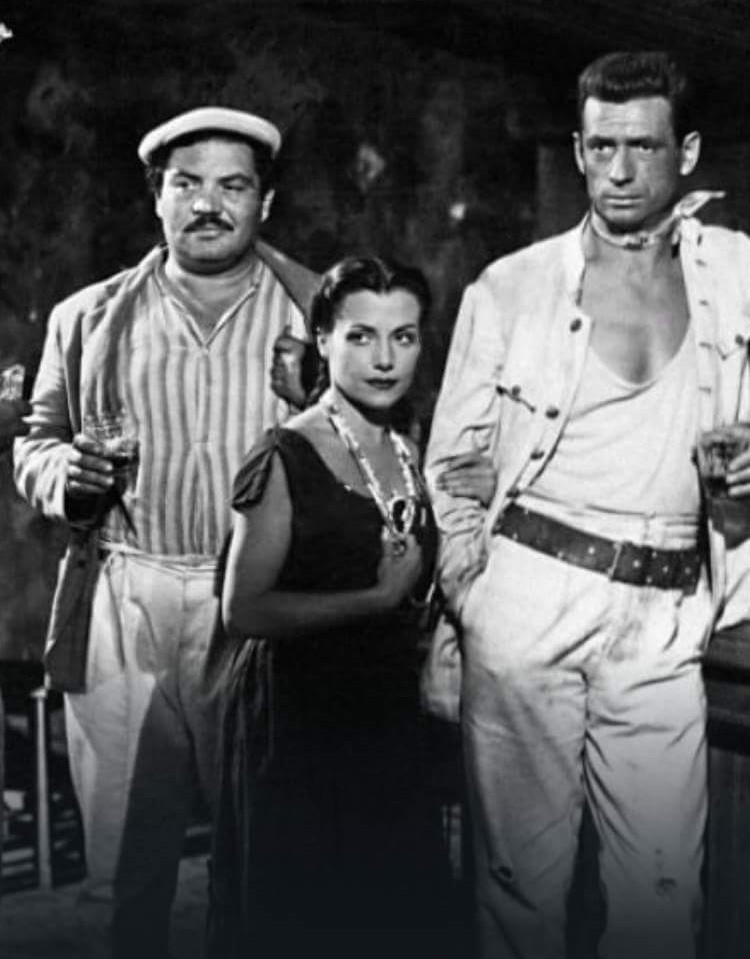
Some of the opening, it has to be said, feels like padding. For instance, what purpose does Linda (played by the director’s wife) have, except to be attractive? A nod toward equality is given by a woman who riles up a crowd, but it doesn’t lead anywhere.
Once we’re on the road, the film improves markedly. There are sequences of suspense that hold up terrifically today. That bridge, man! Or the gushing oil, and the terrifying revelation of a crushed leg.
The ending doesn’t work, at least for me. Our hero shrugs off his friend’s death too quickly, until his jaunty ride home (intercut with celebratory dancing) ends in his death. I’m not against tragic endings; nor am I convinced they’re necessarily truer or wiser. Better, I think, to have him live, and to torture himself with the question of whether it was all truly worth it.
What makes Wages of Fear notable is the way it handled tension and suspence. Anyone making a suspense movie or even book would be missing out if they didn’t watch this film and take notes on how it accomplishes its goals.
I first came across the film years ago, drawn in by the iconic image of an open-mouthed man drowning in oil on the cover of the DVD case. The image stuck with me, and I wanted to find out more. The beginning of the film, however, struggles. While trying to define characters and their motivations, it fails and instead gives us several loosely linked scenes surrounding a bar in the middle of some unnamed Central or possibly South American (depending on who you ask) village named Las Piedras and several people trying to find enough money to escape it.
The set was apparently difficult as the director suffered a broken ankle, the main actress developed pneumonia, and two of the main actors developed conjunctivitis due to conditions the Southern France set according to some sources. I believe it. The movie took risks from its anti-American stance, to its risky camera angles, to its use of language and occasional nudity and unexplained suicide (possibly a murder by one of the main characters).
The director definitely has a very low opinion of people, and it shows in the film. A few characters come across as nice (Luigi seems like a decent guy), but most of them are selfish and flawed. This is perhaps due to the director’s experiences during World War II and afterwards: they turned Cluzot into quite the pessimist and fatalist, and this movie shows it.
The middle of the film is where the movie shines, and I’d say the film starts (or should start) when the candidates are being interviewed to drive truckloads of nitro glicerine across rough terrain to stop a oil well fire. The close-up shots, the unexpected twists, and the tense situations they need to get through become masterful in execution and mimicked to this day.
It is this part of the film that solidifies it as a classic, and one of the best films of the genre. The director went on to direct Les Diaboliques, which I’d argue is a better film. The director learned from his experiences here, and gained enough fame to win out against Hitchcock with that film, but that’s a review for later.
With the end, this film falters again, giving a anticlimactic ending that doesn’t really work for me. I watched this film almost feeling like the director made a masterpiece 40-minute film, and then handed it to an understudy to pad the beginning out to be feature-length. While I’d give that 40-minute span a 10/10, the whole film is weakened by the underdeveloped beginning which reduces my rating to 7/10.
3 responses to “Wages of Fear”
Wages of Fear! Almost seventy years later, and it remains gripping.
Well, some of it does, anyway. The beginning is longer than I remember; we’re an hour in before the central drama (driving nitroglycerin-laden trucks) finally revs up.
Some of the opening, it has to be said, feels like padding. For instance, what purpose does Linda (played by the director’s wife) have, except to be attractive? A nod toward equality is given by a woman who riles up a crowd, but it doesn’t lead anywhere.
Once we’re on the road, the film improves markedly. There are sequences of suspense that hold up terrifically today. That bridge, man! Or the gushing oil, and the terrifying revelation of a crushed leg.
The ending doesn’t work, at least for me. Our hero shrugs off his friend’s death too quickly, until his jaunty ride home (intercut with celebratory dancing) ends in his death. I’m not against tragic endings; nor am I convinced they’re necessarily truer or wiser. Better, I think, to have him live, and to torture himself with the question of whether it was all truly worth it.
Three out of four jukebox fights.
100% agree. I think the reason that this film is notable is purely due to the driving section. Almost everything else is pretty meh.
What makes Wages of Fear notable is the way it handled tension and suspence. Anyone making a suspense movie or even book would be missing out if they didn’t watch this film and take notes on how it accomplishes its goals.
I first came across the film years ago, drawn in by the iconic image of an open-mouthed man drowning in oil on the cover of the DVD case. The image stuck with me, and I wanted to find out more. The beginning of the film, however, struggles. While trying to define characters and their motivations, it fails and instead gives us several loosely linked scenes surrounding a bar in the middle of some unnamed Central or possibly South American (depending on who you ask) village named Las Piedras and several people trying to find enough money to escape it.
The set was apparently difficult as the director suffered a broken ankle, the main actress developed pneumonia, and two of the main actors developed conjunctivitis due to conditions the Southern France set according to some sources. I believe it. The movie took risks from its anti-American stance, to its risky camera angles, to its use of language and occasional nudity and unexplained suicide (possibly a murder by one of the main characters).
The director definitely has a very low opinion of people, and it shows in the film. A few characters come across as nice (Luigi seems like a decent guy), but most of them are selfish and flawed. This is perhaps due to the director’s experiences during World War II and afterwards: they turned Cluzot into quite the pessimist and fatalist, and this movie shows it.
The middle of the film is where the movie shines, and I’d say the film starts (or should start) when the candidates are being interviewed to drive truckloads of nitro glicerine across rough terrain to stop a oil well fire. The close-up shots, the unexpected twists, and the tense situations they need to get through become masterful in execution and mimicked to this day.
It is this part of the film that solidifies it as a classic, and one of the best films of the genre. The director went on to direct Les Diaboliques, which I’d argue is a better film. The director learned from his experiences here, and gained enough fame to win out against Hitchcock with that film, but that’s a review for later.
With the end, this film falters again, giving a anticlimactic ending that doesn’t really work for me. I watched this film almost feeling like the director made a masterpiece 40-minute film, and then handed it to an understudy to pad the beginning out to be feature-length. While I’d give that 40-minute span a 10/10, the whole film is weakened by the underdeveloped beginning which reduces my rating to 7/10.