
After completing the haunting and masterful Joan of Arc, Carl Theodor Dreyer decided to venture into a more fantastical story. Originally designed to be a silent film, sound was largely added after-the-fact making this a very dream-like and haunting film that is interrupted by clarifying text-based story descriptions.
This makes the movie somewhat difficult to follow as the text largely pulls you out of the film when it appears and you have to figure out what’s happening again when the scene picks up again. I’ve watched many films with this format before, and many of them were able to portray story elements in a way that didn’t require dialogue. In the times where dialogue was needed, it was inserted in a less-obtrusive way. This movie, however, is more subtle so the effect is more jarring.
This is not to say that the movie is terrible. Far from it. Many of the scenes are very well shot for the time, and the characters are very striking. The most memorable characters to me were the doctor and the father. The doctor was found by the director on a train apparently. When asked if he wanted to be in a film, he reportedly said nothing and got off the train. A few days later he surprisingly agreed and I’m glad he did. It’s not that he was a particularly great actor, but his appearance was just fit for the role itself. The scene at the end of the movie of him drowning in what looked like a room of grain was striking in particular, but also his intense stares while he looked after his patient.
The father of the daughters, one of only two professional actors in this film, was striking in the way he did his scenes. His body language conveyed meaning where other actors (such as our “hero” in the film) weren’t. Even though he dies half-way through the film, I find I remember the scenes he was in more than some of the other actors in the film.
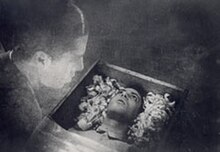
One striking omission of the characters was the vampire herself. Unless I missed an appearance, I only remember her appearing towards the end of the film when her tomb was discovered. I honestly couldn’t describe her to you now only a day later though. There wasn’t anything striking about it. What was more memorable, however, was when the main actor was seeing himself in a coffin in a sort of dream out-of-body sequence. It was there, for a brief moment, that I wondered if he were unknowingly the vampire. He sure looked the part!
In the end, I don’t think the film holds up, but I don’t think that’s what the director was going for. Unlike Joan of Arc or his later films, this film felt like an experiment. A bit like Cocteau’s Blood of a Poet in that the story isn’t necessarily the point that was being made. He was playing around with lighting, and using a soft focus.
There is a visual essay on the Criterion DVD that is referenced in the Wikipedia article that maybe drives this point home best.
When asked about his intention with the film at the Berlin premiere, Dreyer replied that he “had not any particular intention. I just wanted to make a film different from all other films. I wanted, if you will, to break new ground for the cinema. That is all.” Asked if he succeeded, he replied: “Yes, I have broken new ground”.
A lot of the work here helped inform and influence his later (and greater) works in Day of Wrath, Ordet, and Gertrud. For that, I believe, this film is worth watching if only to see the progression of his techniques and skill. If you’re looking for a good vampire film, however, you might be best to look somewhere else.